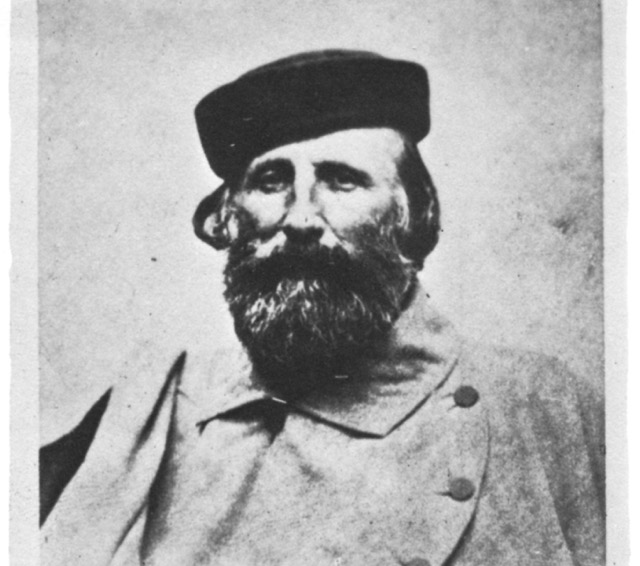
A Life Remembered

Giuseppe Garibaldi

1807 · 1882

Nice, July 4, 1807 · Caprera, Sardinia, June 2, 1882 · aged 74

Sailor, soldier, farmer of Caprera

Written by Come Ricordo

Giuseppe Garibaldi was a sailor before he was anything else. At twenty-six he was sentenced to death for his part in a failed rising in Genoa. He spent twelve years in South America, came home to defend the Roman Republic, and in 1860 sailed with about a thousand volunteers to take Sicily and Naples — then handed both to a king and went back to his farm on a small island off Sardinia.

Few lives of the nineteenth century crossed so much water, or so many causes. This bio follows him from the harbour at Nice to the house on Caprera.
First Years

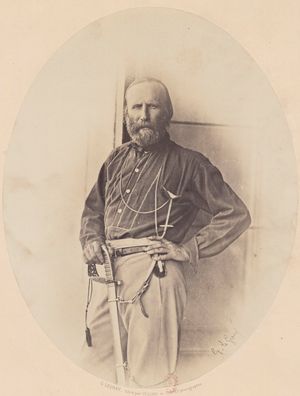
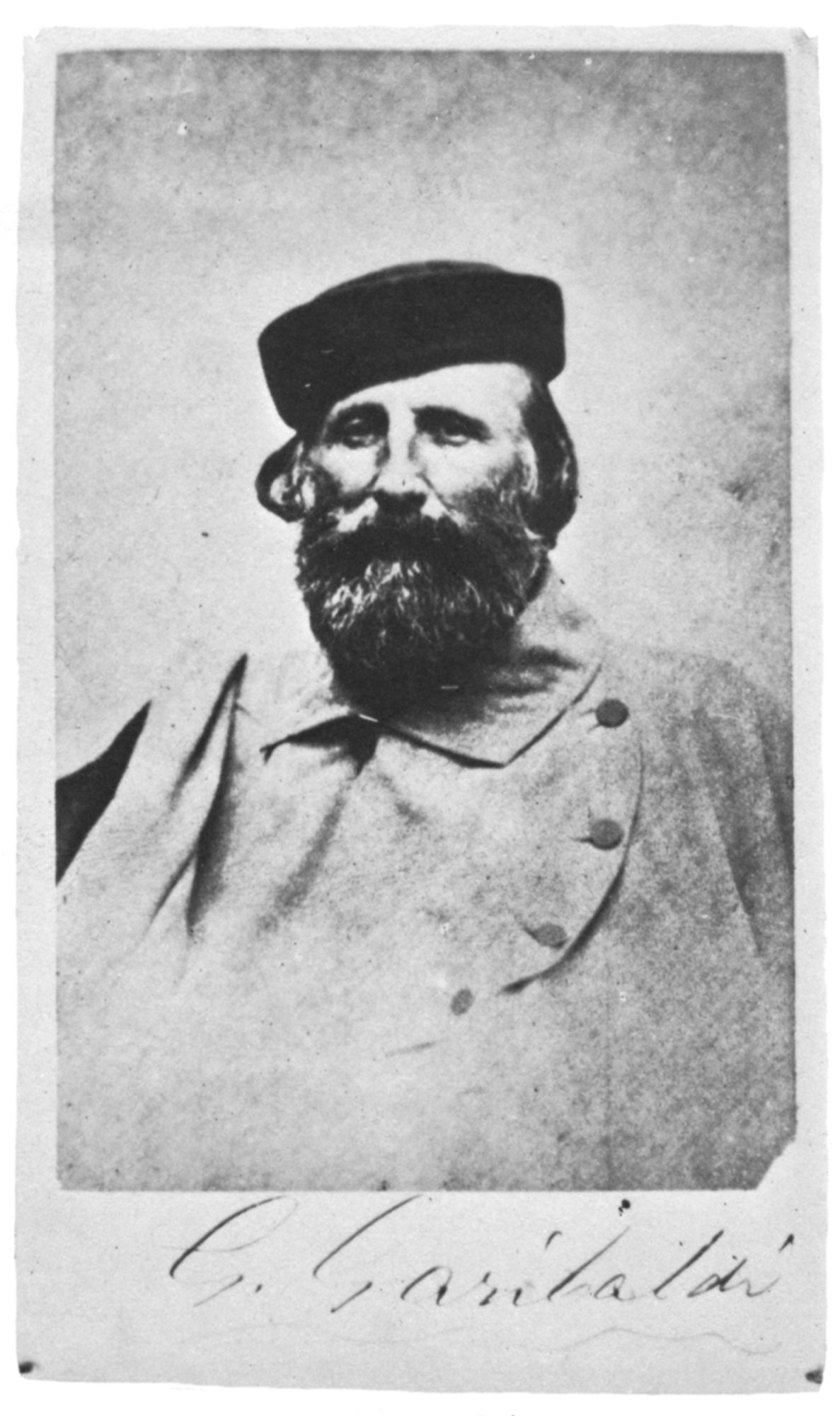
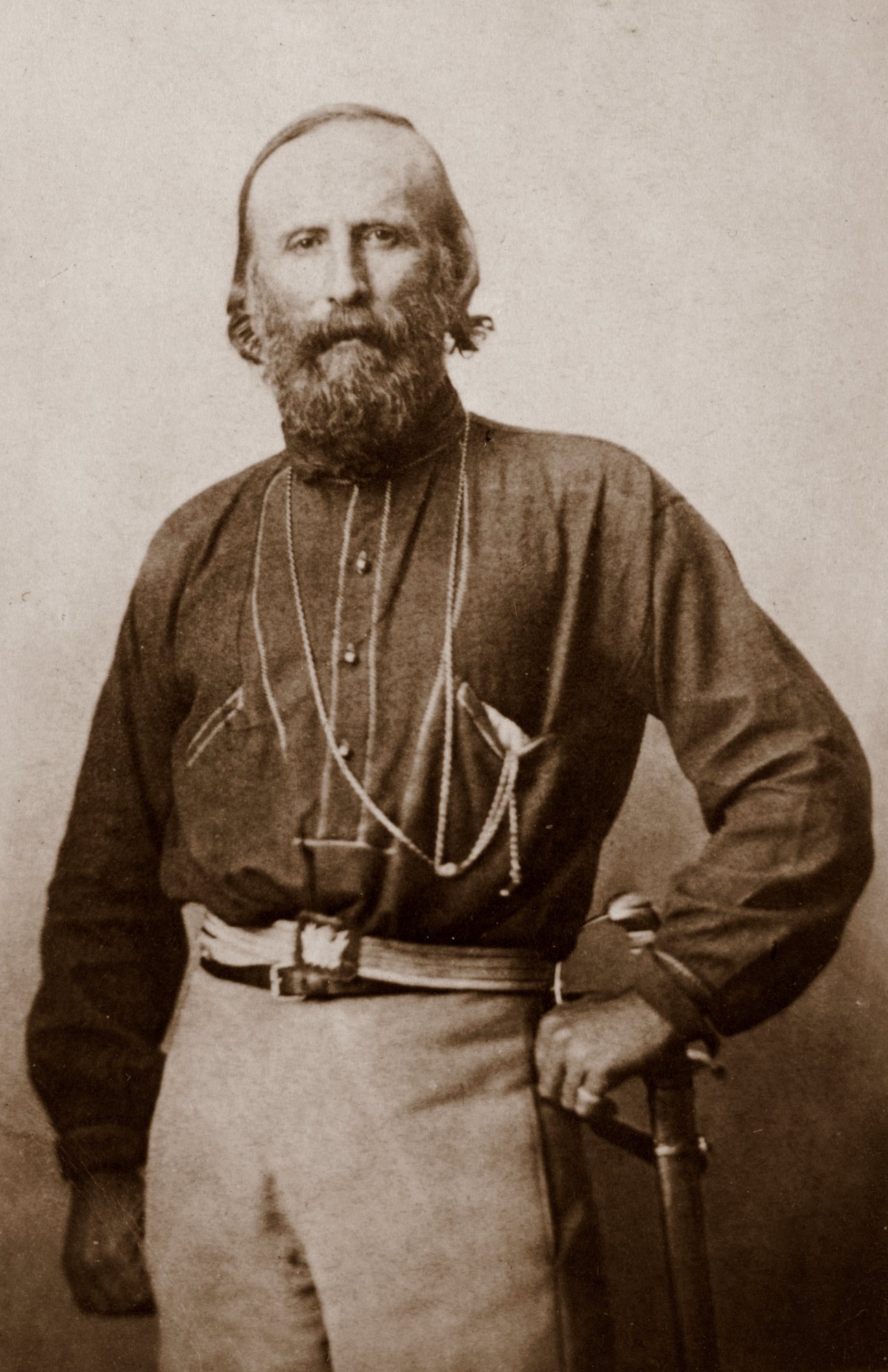
A carte de visite taken in Naples, 1861 (Library of Congress)

He was born on 4 July 1807 in Nice, then part of the French Empire, in a house by the sea. His father, Domenico, was a merchant seaman who traded along the coast; his mother was Rosa Raimondi. Both families came from Liguria. He was the third of six children.

His schooling was patchy — a few private tutors, two of them priests — and the sea won early. He was entered in the register of seamen in November 1821, and in January 1824 he made his first voyage as a cabin boy on the brigantine Costanza, bound for Odessa. The next spring he sailed with his father up the Tiber to Rome, a visit that stayed with him for life.

On a voyage to the Black Sea in 1833 he met exiles and a conspirator of Mazzini’s Young Italy, and came home a convert. That winter he joined the Sardinian navy under a false name to help a planned rising in Genoa. The plot failed in February 1834; he escaped to Marseille, and on 3 June a military court in Genoa sentenced him to death in his absence.

South America

He sailed for Rio de Janeiro in September 1835 under the name Joseph Pane, and arrived at the end of that year. In March 1837 he put to sea in a small boat he had renamed Mazzini, with a dozen men and letters of marque from the rebels of Rio Grande do Sul, then at war with the Brazilian Empire. That June a bullet in the neck nearly killed him; the next year he was captured and tortured.

He went on to command the rebels’ few ships on the coast, and in 1839, at Laguna in Santa Catarina, he met Anita. In 1841 they crossed into Uruguay on a long march — he had been paid in cattle, and none of them survived it — and reached Montevideo that June, where he taught mathematics to make ends meet.

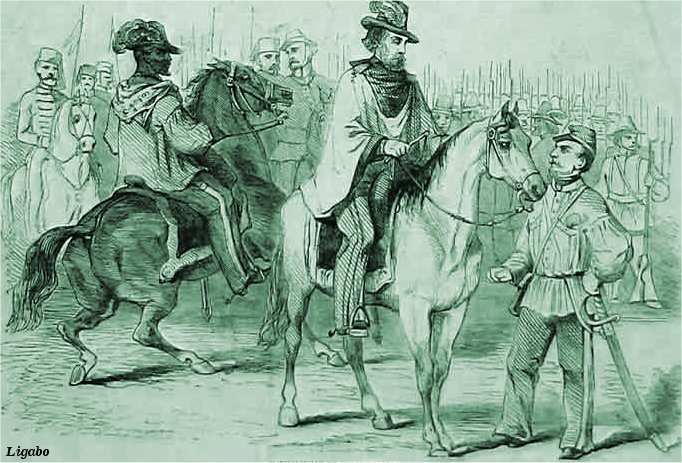
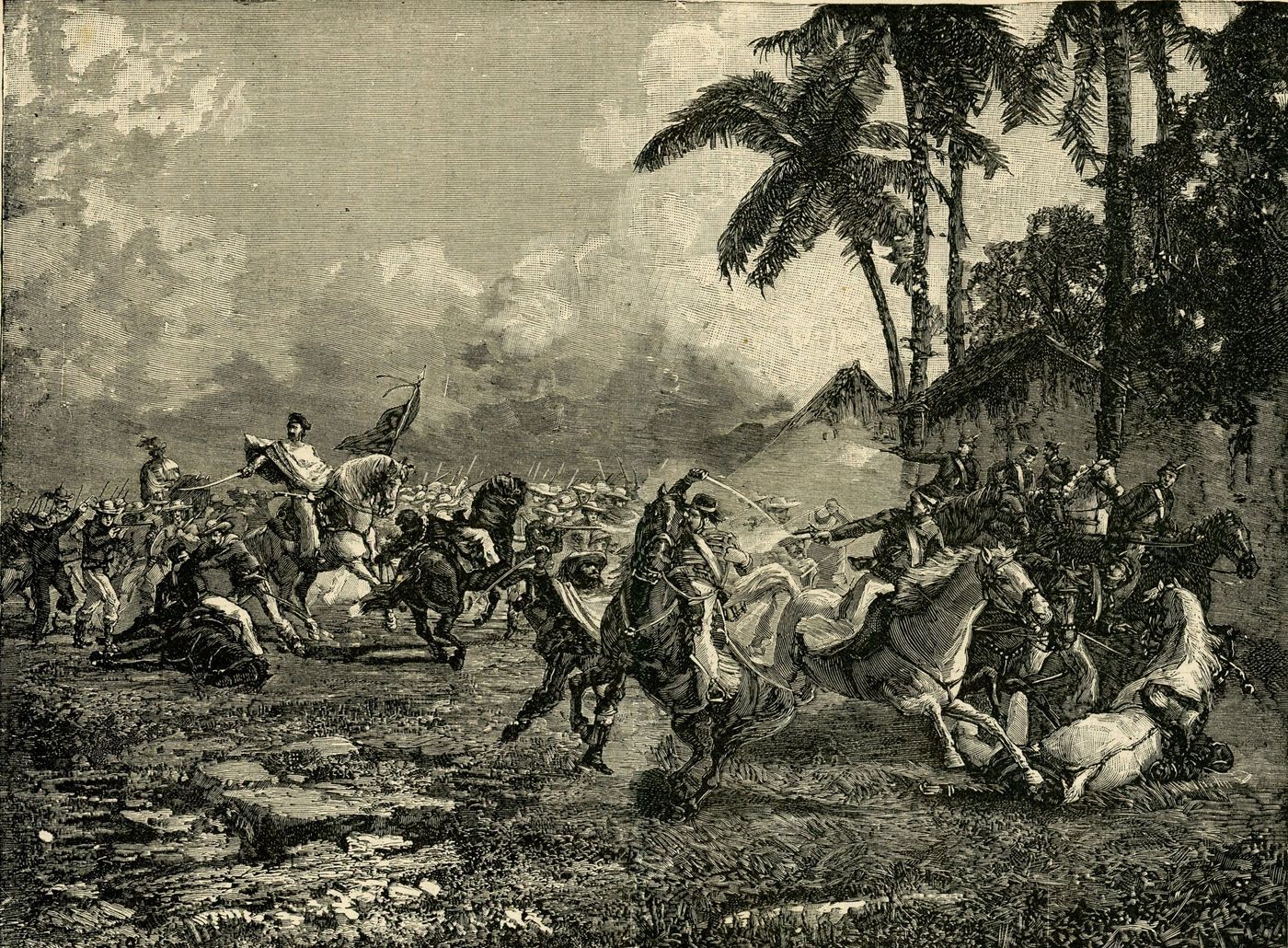
For Montevideo, at war with Argentina, he raised the Italian Legion in 1843: a black flag with a volcano, and red shirts cut from cloth meant for slaughterhouse workers. Its victory at San Antonio del Salto on 8 February 1846 made his name known in Europe. He refused the land the government offered him.

The Italian Legion at San Antonio, Uruguay, 1846 (woodcut, 1899)

Anita

Ana Maria de Jesus Ribeiro was born around 1821 near Laguna. A Santa Catarina court ruling of 1998 gives 30 August 1821 at Morrinhos, now part of Tubarão; some historians argue for Lages, and no record from the time survives. At about fourteen she was married to a shoemaker, Manuel Duarte de Aguiar.

She met Garibaldi at Laguna in October 1839 — in his memoirs he says he first saw her through a telescope from the deck of his ship — and on 23 October she sailed with him. Within weeks she was in the naval fights at Imbituba and Laguna. Later, pregnant, she was captured at Curitibanos and escaped on her own.

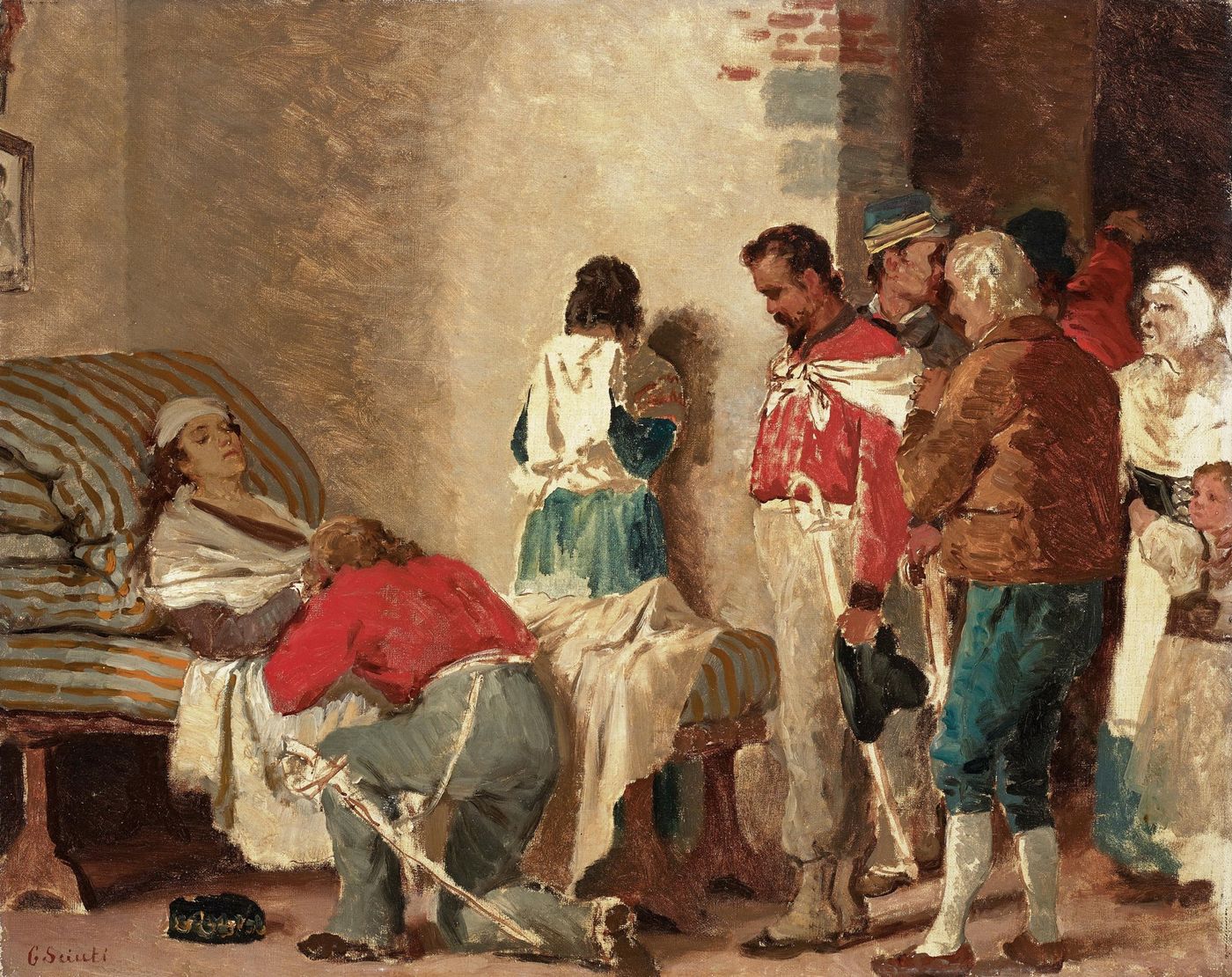
They married in Montevideo in 1842 (on 26 March, by most accounts; one source says 16 June) and had four children: Menotti, Rosita, who died at about two, Teresita and Ricciotti. In 1849 she joined him in besieged Rome and followed him on the retreat. She died on 4 August 1849 at a farm at Mandriole, near Ravenna, pregnant with their fifth child. Sources differ on the cause.

The Roman Republic

He sailed home with about seventy legionaries in April 1848 and landed at Nice on 21 June. After a summer of fighting the Austrians in Lombardy, he went to Rome, where a republic had been declared. On 30 April 1849 his volunteers beat the French outside the city in hand-to-hand fighting, and in May he defeated the Neapolitans at Palestrina and Velletri.

When the Republic fell in July he left Rome with some four thousand men, hoping to reach Venice. Austrian ships forced him ashore on the Adriatic coast, and Anita died during the pursuit. He made his way across Romagna and Tuscany, was arrested at Chiavari, and on 16 September 1849 was sent into exile again.

Exile

In Tangier he began writing his memoirs. On 30 July 1850 he reached New York, where he worked in Antonio Meucci’s candle factory on Staten Island. Then he went back to sea: Central America, Peru, a voyage as captain to Canton in China. His mother died in Nice in 1852; their children had been in her care.

He was back in Italy by 1854 and, with an inheritance from his brother Felice, bought part of the small island of Caprera, north of Sardinia, in 1855–56. He had given up the republican line: he would make Italy with the House of Savoy.

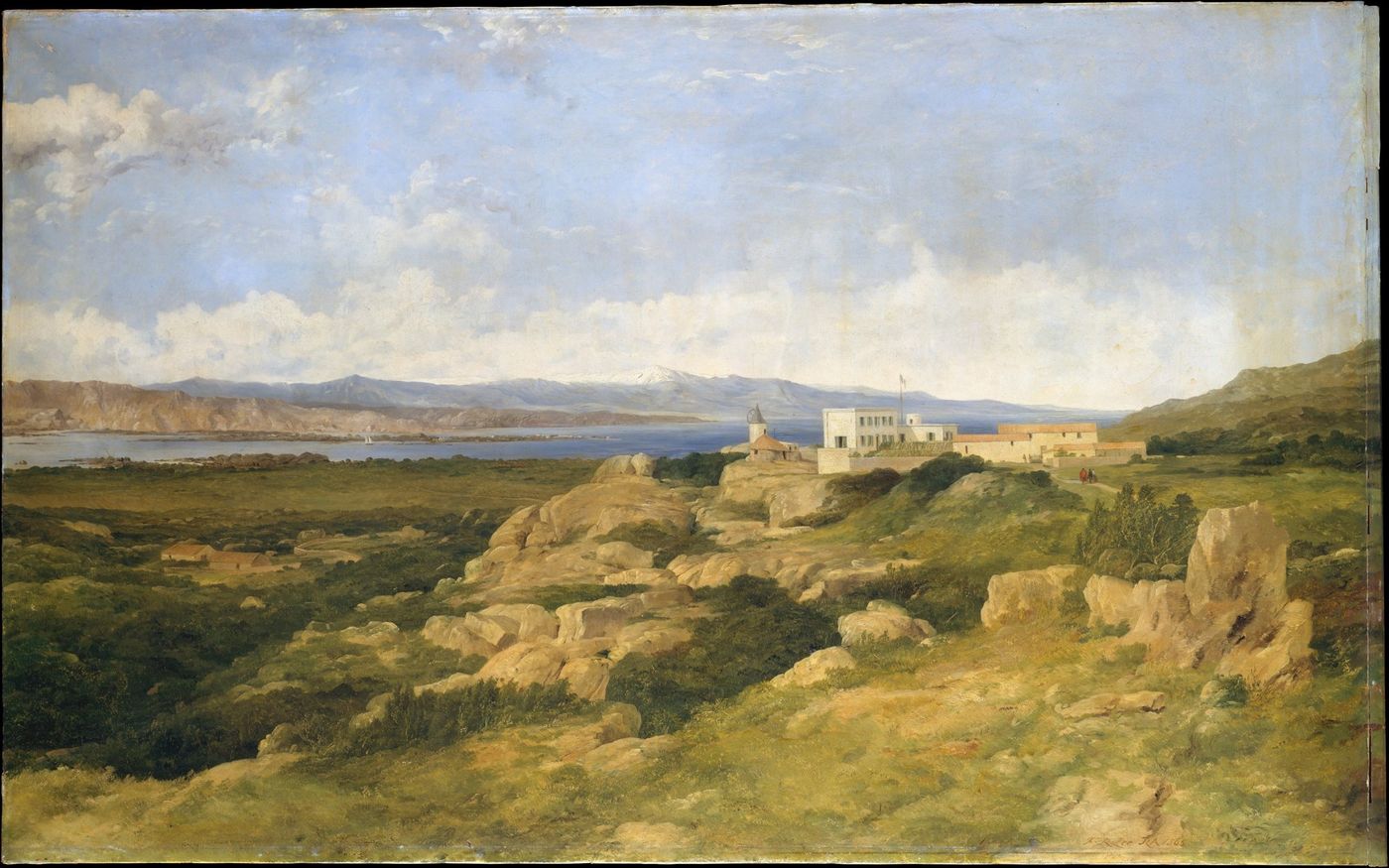
His house on Caprera, painted by F. R. Lee, 1865

The Thousand

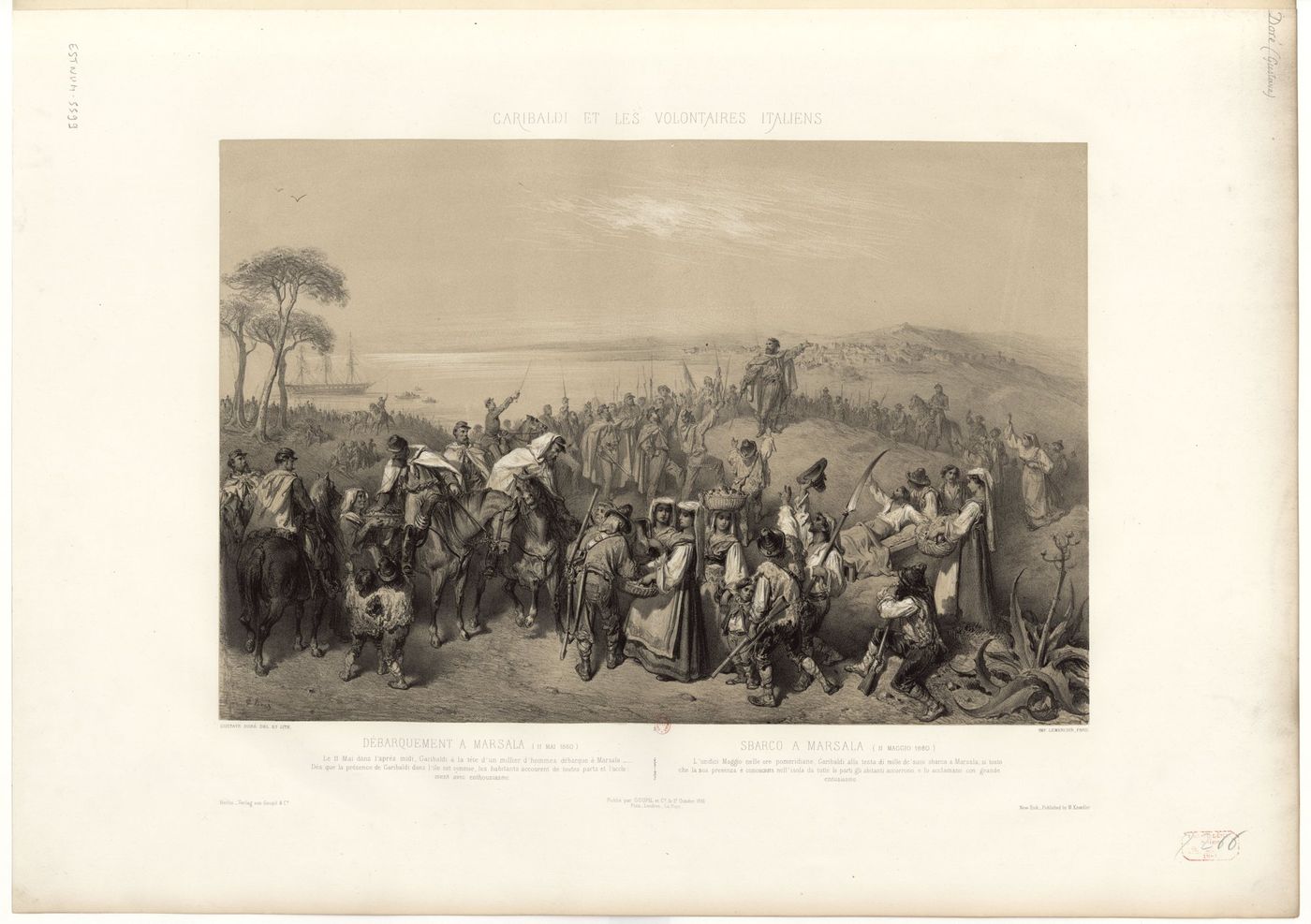
On the night of 5–6 May 1860 he sailed from Quarto, near Genoa, with about a thousand volunteers on two steamers, the Piemonte and the Lombardo. They landed at Marsala on 11 May. Four days later they won at Calatafimi, and by the end of the month they were fighting in the streets of Palermo.

Milazzo followed in July. On 19 August he crossed the Strait of Messina, on 7 September he entered Naples, and on 1–2 October he held the line at the Volturno. On 26 October he met King Victor Emmanuel II and greeted him as King of Italy — at Teano, as the story is told, though some historians place the handshake a few miles away, near Vairano.

He handed over the south he had won, refused rank and reward, and on 9 November left for Caprera.

The landing at Marsala, 11 May 1860, lithograph by Gustave Doré, 1861

Later Years

Garibaldi photographed by Nadar, Paris, 1870

“Rome or death”: in 1862 he tried to take Rome with volunteers and was stopped by Italian troops at Aspromonte on 29 August, wounded in the right ankle. He limped for the rest of his life. Two years later London gave him a hero’s welcome, and on the Isle of Wight he called on the poet Tennyson.

In 1866 he led volunteers into the Trentino and, ordered to withdraw, answered with one word: “Obbedisco” — “I obey”. In 1867 he tried for Rome again and was defeated at Mentana on 3 November.

In 1870, at sixty-three, he went to fight for the new French Republic. At Dijon in January 1871 his Army of the Vosges took the only Prussian flag captured in the whole war. Elected to the French National Assembly, he was shouted down at Bordeaux; Victor Hugo rose to defend him.

Timeline

  1. July 4, 1807Born in Nice
  2. January 1824First voyage, as a cabin boy, to Odessa
  3. June 3, 1834Sentenced to death in absentia in Genoa
  4. October 23, 1839Anita sails with him from Laguna
  5. February 8, 1846Victory at San Antonio del Salto, Uruguay
  6. April 30, 1849Beats the French outside Rome
  7. August 4, 1849Death of Anita near Ravenna
  8. July 30, 1850Arrives in New York
  9. May 11, 1860The Thousand land at Marsala
  10. October 26, 1860Meets King Victor Emmanuel II
  11. August 29, 1862Wounded at Aspromonte
  12. November 3, 1867Defeated at Mentana
  13. January 21, 1871Defence of Dijon begins
  14. June 2, 1882Dies on Caprera

What Others Said

“I will say that he is the only one of the generals who fought for France, the only one who was not defeated.”
Victor Hugo, National Assembly, Bordeaux, 8 March 1871 (translated from the French)
“What a noble human being! I expected to see a hero and I was not disappointed.”
Alfred Tennyson, letter to the Duke of Argyll, April 1864
“His face very noble, powerful, and sweet, his forehead high and square. … His manner was simple and kind.”
Emily Tennyson, her journal, April 1864

Photos

A carte de visite taken in Naples, 1861 (Library of Congress)
The Italian Legion at San Antonio, Uruguay, 1846 (woodcut, 1899)
Garibaldi photographed by Nadar, Paris, 1870
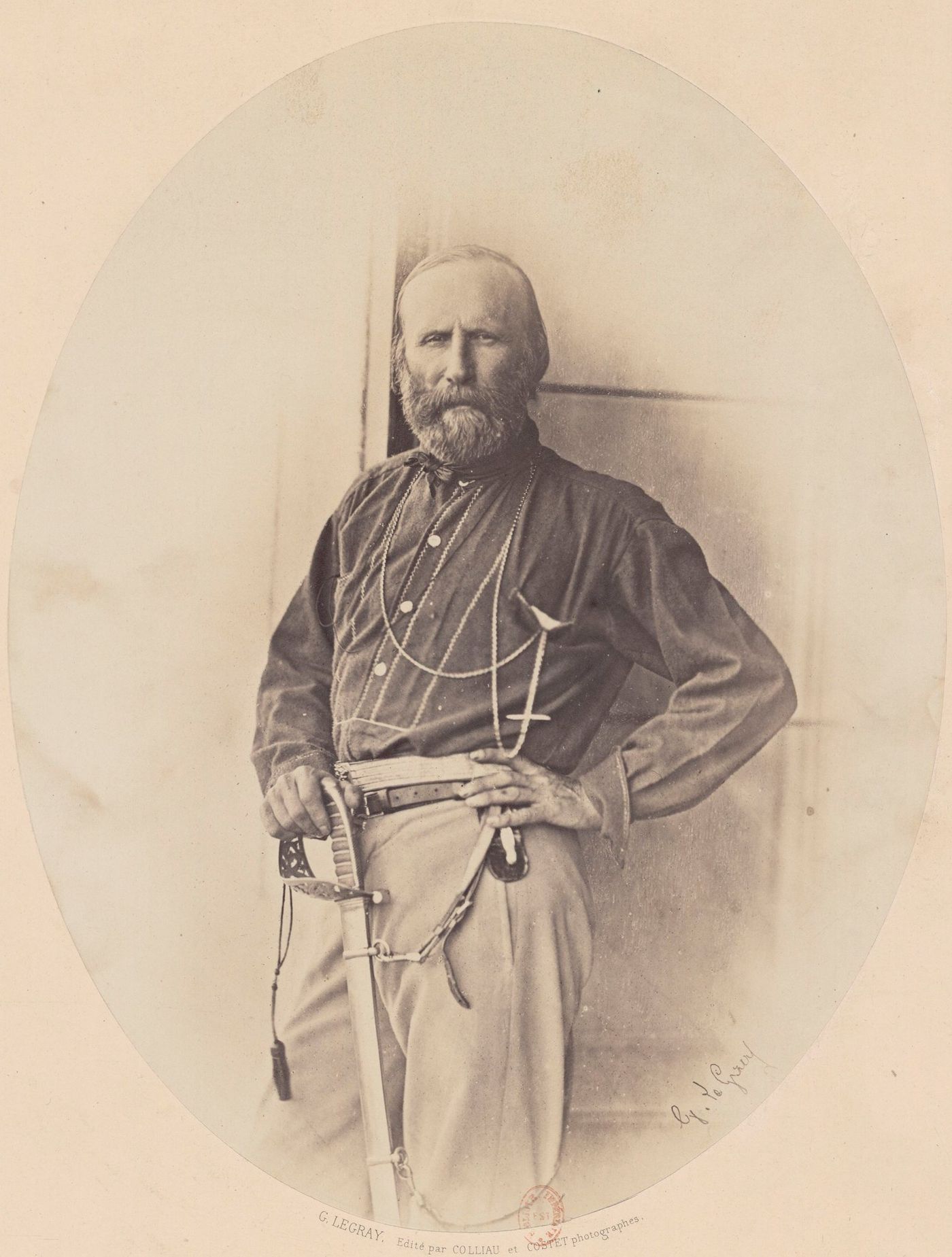
In Palermo, July 1860, photographed by Gustave Le Gray
The landing at Marsala, 11 May 1860, lithograph by Gustave Doré, 1861
His house on Caprera, painted by F. R. Lee, 1865
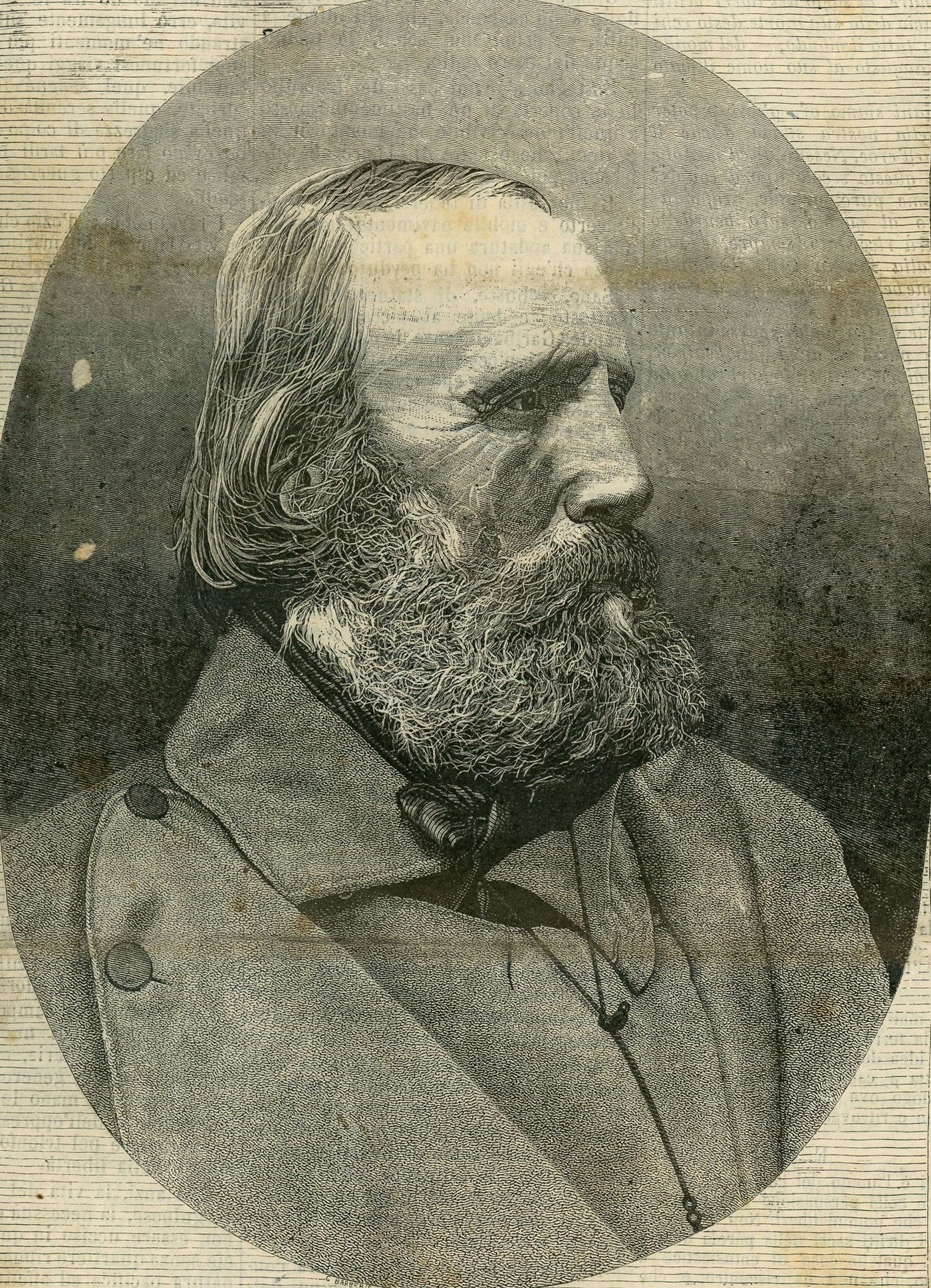
His death on Caprera, 2 June 1882 (woodcut, L’Illustrazione popolare)

In Closing

He spent his last years on Caprera, farming with his son Menotti and writing — three novels, and the memoirs he had begun in Tangier, finished in 1872. In 1880 he married Francesca Armosino, the mother of his youngest children. Arthritis left him almost unable to move, but in the spring of 1882 he still travelled to Naples and Palermo.

He died on Caprera on the afternoon of 2 June 1882. He had asked to be cremated; instead he was buried on the island, where his house and his grave are national monuments.

His death on Caprera, 2 June 1882 (woodcut, L’Illustrazione popolare)

Sources

Everything in this bio comes from these works. Where they disagree — Anita’s birthplace, the date of their wedding, the place where he met the King — the text says so.

  1. Giuseppe Monsagrati, “Garibaldi, Giuseppe”, Dizionario Biografico degli Italiani, vol. 52. Rome: Istituto della Enciclopedia Italiana (Treccani), 1999. treccani.it
  2. “Garibaldi, Giuseppe” and “Garibaldi, Anita”, Enciclopedia on line, Treccani. treccani.it
  3. Giuseppe Garibaldi, Autobiography of Giuseppe Garibaldi, translated by A. Werner. London: Walter Smith and Innes, 1889. archive.org
  4. “Garibaldi, Anita (c. 1821–1849)”, Women in World History: A Biographical Encyclopedia, via encyclopedia.com
  5. Assembleia Legislativa de Santa Catarina, “A controvérsia sobre o local de nascimento” (on Anita’s birthplace), 29 July 2021. alesc.sc.gov.br
  6. Victor Hugo, Actes et paroles — Depuis l’exil, “Bordeaux”, session of 8 March 1871. fr.wikisource.org
  7. Hallam Tennyson, Alfred Lord Tennyson: A Memoir by His Son, vol. II. London: Macmillan, 1897. archive.org
  8. Images: Wikimedia Commons, public domain or CC0 — Nadar (1870); Gustave Le Gray (1860, BnF); Library of Congress (1861); Gustave Doré (1861, BnF); L’Illustrazione popolare (1899); The Illustrated London News (1849); F. R. Lee (1865, The Metropolitan Museum of Art); Giuseppe Barberis, L’Illustrazione popolare (1882); Giuseppe Sciuti, The Death of Anita Garibaldi (before 1911, private collection).

Comments

Log in to leave a comment. You'll come straight back here.Log in to comment

Loading comments…

Suggest a correctionNo account? Write to info@teaminova.com

This page online: comoricordo.com/b/11

Made with Come Ricordo · comoricordo.com